

⠀⠀⠀⠀⠀⠀⠀⠀⠀⠀⠀⠀⠀⠀ㅤㅤㅤㅤ
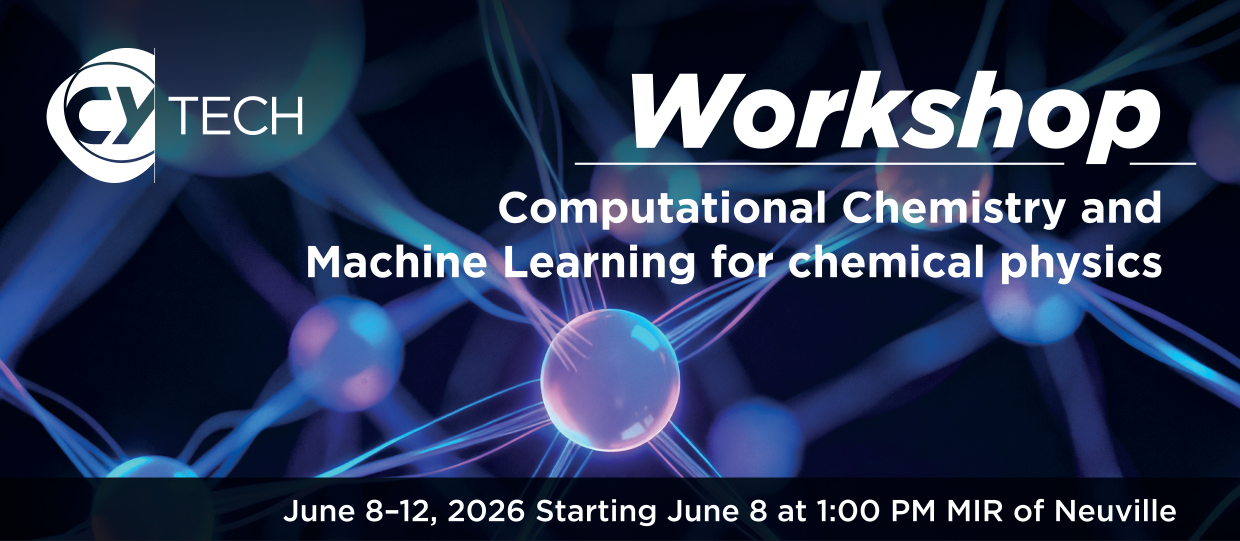
Following the success of the Workshop on computational chemistry and machine learning for chemical physics organized in 2025, the laboratory will host a full week dedicated to computational chemistry and machine learning for chemical physics and related matters.
This week will take place from the 8th to the 12th of June 2026, and will be split in two parts. The first part of the week will take the form of a scientific conference (8-10 June), regrouping researchers in these fields, while the second half of the week will be dedicated to practicals (11-12 June), given by experts, and scientific collaborations for those interested.
Objectives:
-
Bring together researchers and students interested in computational chemistry and physics.
-
Present a series of invited talks from experts in the field, covering theoretical foundations, recent developments, and case studies.
-
Demonstrate the role of computational simulations in bridging theory and experiment.
-
Introduce emerging trends, including machine learning and AI-driven approaches in computational chemistry and physics.
-
Foster collaborations and knowledge exchange.
-
Bring together researchers and students interested in computational chemistry and physics.
-
Discuss how to impulse a dynamic in this field at CYU and associated partners.
-
A tutorial session on Quantum Chemical Computations.
Invited Speakers:
-
Duncan Bossion, Université de Rennes
-
Marie-Pierre Gaigeot, Université d'Evry val d'Essone Paris
-
Majdi Hochlaf, Université Gustave Eiffel
-
Bogdan Iorga, Université Paris-Saclay
-
Liuba Mazzanti, Université Paris-Saclay
-
Gunnar Nyman, University Of Gothenburg
-
Rita Prosmiti, Institute of Fundamental Physics, Madrid
-
Alejandro Rivero Santamaria, Université de Lille
Schedule:
The schedule communicated now is an early preview of the actual schedule and is subject to evolve. Please check back later for the complete schedule.
-
Monday, 8th of June, afternoon: Scientific sessions
-
Tuesday, 9th of June, entire day: Scientific sessions
-
Wednesday, 10th of June, morning: Scientific sessions
-
Thursday, 11th of June, entire day: Practicals
-
Friday, 12th of June, entire day: Practicals
Scientific Organizing Committee:
François Dulieu
Florian Gallier
Dimitrios Kotzinos
Michel Lorin
Sebastien Peralta
Guy Trambly De Laissardière
Llinersy Uranga Pina
Sameera WMC
Location:
Maison internationale de la recherche, Neuville campus
Adress: 1 Rue Descartes, 95000 Neuville-sur-Oise, France
Practical Sessions:
During the last two days of the week, hands-on tutorial sessions in computational chemistry and machine learning will be held at CY Cergy Paris Université (Neuville). Sessions will be delivered in person and/or online, and are designed for beginners, with step-by-step guidance and practical examples.
The thursday session will be focused on computationnal chemistry and will cover: (More details: See PDF at the bottom of the page)
-
Introduction to computational chemistry
-
Setting up and running electronic structure calculations
-
Reaction pathway calculations and thermochemical and kinetic analysis
-
Multi-scale models
The friday session will be dedicated to Artificial intelligence and will be divided in 6 modules: (More details: See PDF at the bottom of the page)
-
Introduction: Basic concepts of Machine learning
-
Denoising: Spectral signals
-
Mapping, extraction of main features: Spectra, images
-
Morphometry: Microscopy
-
Computer vision: Failure detection, main features detection in images
-
Collaborative group projects: Related projects of general interest.
Registration:
The event is free to attend.
To register, please fill the following form before May 10th 2026: https://forms.gle/SHGPYmug1hvHXWfC9
The scientific sessions will take place in person, and may be broadcast and recorded if the speaker agrees. The practical sessions will be hybrid online/in-person.
To apply for an oral or poster presentation, email us directly, using the template provided at the bottom of this page, or at the following link: https://tinyurl.com/yzdrxtt7
Contact:

Documents to download
- Abstract template DOC, 32 kB
- Workshop_LIRA-ChemPhys_and_IA-1.pdf PDF, 121 kB
- Quantum_Chemistry_Program.pdf PDF, 39 kB